
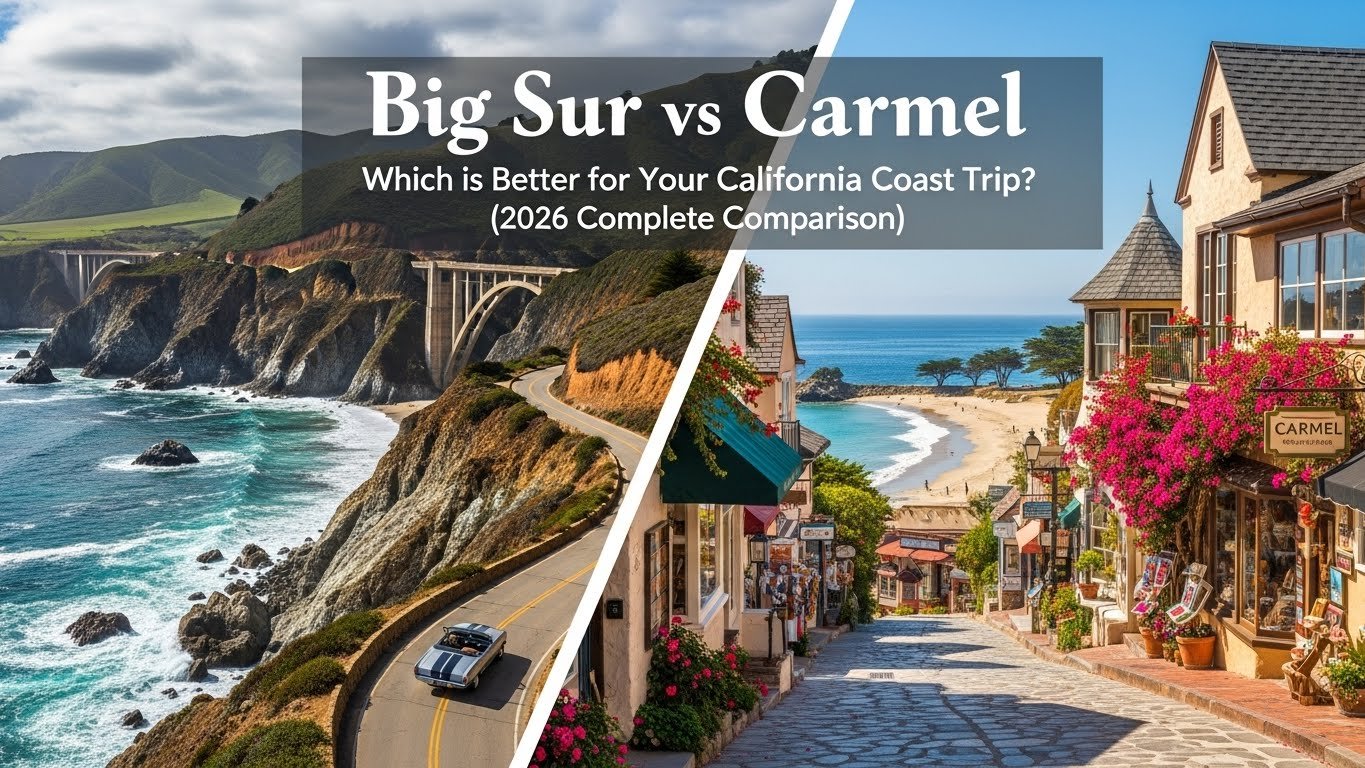
I’m standing at a scenic pullout along Highway 1, trying to explain to my friend why we’re driving past Carmel-by-the-Sea without stopping. “We’ll come back,” I promise, watching her disappointed face as we continue south toward Big Sur. Three days later, after hiking redwood canyons and watching sunset from clifftop campsites, she understood—but she also insisted we spend our final two nights in Carmel, and honestly, I’m glad she did. After six trips to California’s Central Coast over the past five years, I’ve learned that Big Sur vs Carmel isn’t actually a competition where one destination beats the other. They’re completely different experiences that both deserve your time, and choosing between them depends entirely on what kind of California coast trip you’re seeking. Big Sur delivers raw, dramatic wilderness with towering cliffs, ancient redwoods, and that remote, end-of-the-world atmosphere where you’ll spend days hiking, camping, and connecting with nature. Carmel provides sophisticated small-town charm with art galleries, wine tasting rooms, boutique shopping, white-sand beaches, and upscale dining in a walkable village where you can park your car and explore on foot for days. This comprehensive comparison will help you decide which destination matches your travel style—or better yet, how to experience both during one incredible Central California coast adventure.
Quick Comparison: Big Sur vs Carmel-by-the-Sea
| Category | Big Sur | Carmel-by-the-Sea |
|---|---|---|
| Type | 90-mile wilderness coastline | Charming coastal village |
| Best For | Nature lovers, hikers, campers, photographers | Couples, foodies, wine lovers, shoppers |
| Accommodation | Limited, rustic to luxury ($100-$1,500+) | Abundant, boutique hotels/B&Bs ($200-$600+) |
| Dining | Few restaurants, mostly casual ($15-40) | Excellent scene, fine to casual ($20-80+) |
| Activities | Hiking, camping, beach walks, scenic drives | Wine tasting, galleries, beach walks, shopping |
| Walkability | Requires driving between sites | Entire village walkable |
| Crowd Level | Moderate to low (depends on season) | Moderate year-round |
| Cell Service | Spotty to non-existent | Excellent |
| Budget | $150-300/day per person | $200-400/day per person |
| Ideal Length | 2-3 days | 2-3 days |
What Actually IS Big Sur vs Carmel? (Understanding the Difference)
This might seem obvious, but I’ve met dozens of travelers who don’t understand the fundamental difference between Big Sur and Carmel until they arrive. Big Sur isn’t a town—it’s a 90-mile stretch of dramatic coastline running roughly from Carmel Highlands south to San Simeon. There’s no downtown Big Sur, no Main Street to walk, no central location where “everything happens.” Instead, you’ll find a few scattered communities (Big Sur Village being the largest), isolated lodges, campgrounds, state parks, and miles of wilderness connected by Highway 1.
Carmel-by-the-Sea, in contrast, is an actual incorporated village of about 3,800 residents covering roughly one square mile. You can walk from one end to the other in 20 minutes. The downtown features tree-lined streets, fairy-tale cottages, art galleries, wine tasting rooms, boutique shops, and excellent restaurants all within easy walking distance of Carmel Beach.
Think of it this way: Big Sur is where you go to escape civilization and immerse yourself in nature. Carmel is where you go to enjoy sophisticated small-town luxury while still having ocean access. They’re complementary experiences, not competing ones.
Big Sur: What Makes It Special
The Landscape and Atmosphere
Big Sur’s drama comes from geography. The Santa Lucia Mountains rise abruptly from the Pacific Ocean, creating some of California’s most spectacular coastal scenery—sheer cliffs dropping hundreds of feet to crashing waves, Highway 1 carved into mountainsides with heart-stopping curves and panoramic ocean views, ancient redwood canyons just yards from beaches, and that constant sense of wilderness and remoteness.
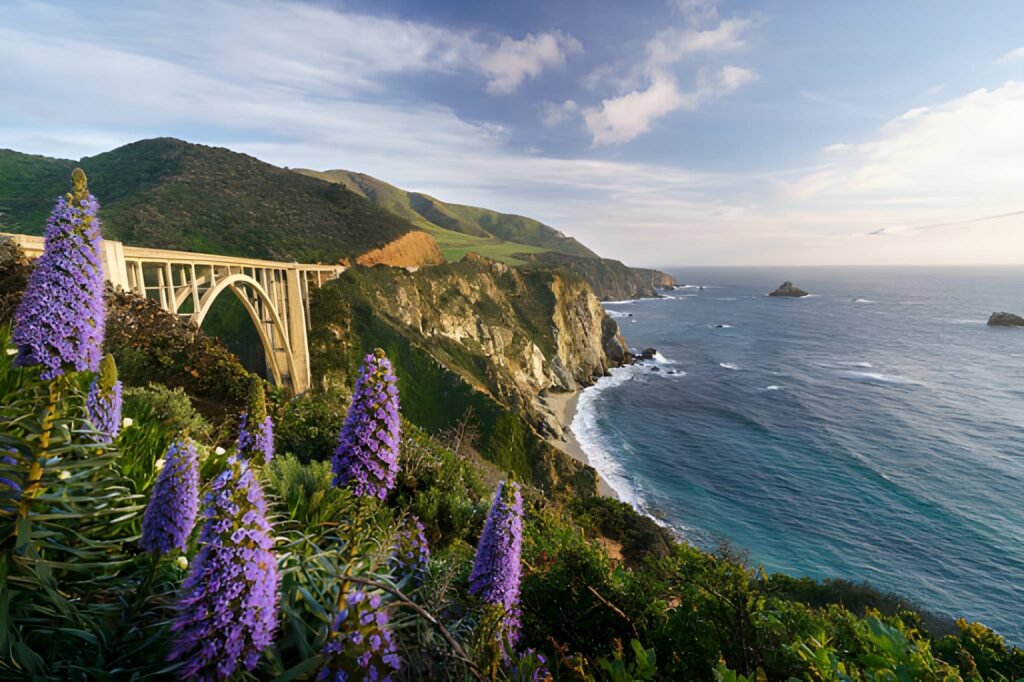
I’ve driven Highway 1 through Big Sur maybe twenty times, and it never stops being breathtaking. Every turn reveals another postcard view—Bixby Bridge arching across a canyon with ocean backdrop, McWay Falls dropping directly onto beach sand (one of only two tide falls in California), rocky headlands where sea otters float in kelp forests. The landscape feels alive, powerful, and slightly intimidating in the best possible way.
The atmosphere here is decidedly bohemian and low-key. Even the most upscale Big Sur lodges maintain a rustic, nature-focused vibe. You won’t find luxury shopping or fine dining—you’ll find campfires, hiking boots, field guides to coastal wildflowers, and people who came here specifically to disconnect from normal life.
Where to Stay in Big Sur
Accommodation in Big Sur falls into three categories: ultra-luxury resorts, rustic cabins and lodges, and campgrounds. There’s not much middle ground.
Luxury Options ($600-2,000/night):
- Post Ranch Inn consistently ranks among America’s best hotels with clifftop rooms, infinity pools overlooking the Pacific, and that “worth every penny” luxury that justifies the $1,200-2,000 nightly rates.
- Ventana Big Sur offers similarly upscale experience with Japanese-inspired design, excellent spa, and rates running $800-1,500 nightly.
Mid-Range Lodges ($150-400/night):
- Big Sur River Inn sits alongside the Big Sur River (where you can actually swim in summer), offers simple cabins and rooms, reasonable restaurant, and that classic Big Sur atmosphere at more accessible pricing ($150-300).
- Deetjen’s Big Sur Inn provides rustic historic cabins with no TVs or phones—authentically bohemian accommodations built in the 1930s ($150-250).
- Ripplewood Resort and Fernwood Resort offer basic cabins in redwood forests ($100-200).
Camping ($35-50/night):
- Pfeiffer Big Sur State Park (189 sites in redwood canyon)
- Kirk Creek Campground (clifftop sites with dramatic ocean views)
- Andrew Molera State Park (walk-in tent camping)
The limited accommodation means booking far ahead—2-3 months minimum for summer weekends, 3-6 months for luxury properties. Last-minute Big Sur stays are nearly impossible during peak season.
What to Do in Big Sur
Big Sur’s activities center on nature immersion rather than traditional tourism.
Hiking dominates most itineraries. Top trails include:
- McWay Falls Trail (0.6 miles, easy, overlooks the famous waterfall)
- Partington Cove Trail (1.2 miles, moderate, descends to secluded cove)
- Ewoldsen Trail (4.5 miles, moderate, loops through redwoods with ocean views)
- Sykes Hot Springs (10 miles one-way, strenuous, natural hot springs by river—requires backcountry permit)
Beach Access requires more effort than you’d expect. Most Big Sur beaches involve steep trails or 4WD access. Sand Dollar Beach offers the easiest access with actual parking and restrooms. Pfeiffer Beach (purple sand from manganese garnet in the rocks) requires a narrow, unmarked access road but delivers stunning rock formations.
Scenic Stops along Highway 1:
- Bixby Bridge (most photographed bridge in California)
- Point Sur Lightstation (guided tours available)
- McWay Falls overlook at Julia Pfeiffer Burns State Park
- Numerous pullouts for photography and whale watching (December-April)
Dining in Big Sur:
- Nepenthe (casual, spectacular views, burgers and salads, $15-30)
- Big Sur Bakery (breakfast/lunch, excellent pastries and pizza, $12-25)
- Deetjen’s Restaurant (breakfast/dinner in historic inn, $15-35)
- Sierra Mar at Post Ranch Inn (fine dining with ocean views, $60-150)
Big Sur Challenges and Considerations
Highway 1 through Big Sur closes regularly due to landslides and storm damage. Major closures can last months—the 2017 Pfeiffer Canyon Bridge collapse closed the road for over a year. Always check current conditions before visiting (Caltrans QuickMap or Big Sur California websites).
Cell service is essentially non-existent throughout Big Sur. T-Mobile, AT&T, and Verizon all have minimal to zero coverage for most of the 90-mile stretch. Download maps, directions, and any necessary information before arrival.
There are almost no services—two small markets (overpriced, limited selection), one gas station (expensive, sometimes closes unexpectedly), and no ATMs in the southern section. Bring cash, fill your tank in Carmel or Cambria, and pack food/snacks if you’re budget-conscious.
Weather brings frequent fog, especially May through August. Morning fog often burns off by afternoon, but plan for layers regardless of season. Summer temperatures range 50-70°F, winter 45-60°F—it’s never truly warm.
Carmel-by-the-Sea: What Makes It Special
The Village Atmosphere
Carmel feels like someone designed the perfect California coastal village and then actually built it. Streets have names like Ocean Avenue, Dolores Street, and Monte Verde—no street numbers or addresses (officially banned, though most businesses quietly add them). Sidewalks are uneven and charming. Trees arch over narrow lanes. Cottages with fairy-tale rooflines sit next to art galleries in converted homes.
The town maintains strict aesthetic codes that prevent chain restaurants (you won’t find McDonald’s or Starbucks), prohibit high heels on sidewalks without permits (yes, really—the law dates to 1920s and prevents lawsuits), and generally preserve the village’s character. The result feels timeless, elegant, and remarkably walkable.
Carmel attracts an affluent, cultured crowd—retirees, weekending Bay Area professionals, honeymooners, and tourists seeking upscale experiences. The vibe leans sophisticated rather than laid-back, though it never feels pretentious or exclusive. Everyone’s welcome, and the friendliness surprises first-time visitors.
Where to Stay in Carmel
Carmel offers far more accommodation variety than Big Sur, from budget motels to luxury boutique hotels.
Luxury Options ($400-800/night):
- L’Auberge Carmel (Michelin-starred restaurant, European elegance, $500-800)
- Carmel Beach Hotel (chef-driven restaurant, beach proximity, $475-700)
- Tradewinds Carmel (boutique hotel with fireplaces, $450-650)
- Cypress Inn (co-owned by Doris Day, pet-friendly luxury, $400-600)
Mid-Range ($200-400/night):
- Hofsas House Hotel (Bavarian-themed, central location, $220-350)
- Lamp Lighter Inn (cottage-style near beach, $250-400)
- Carmel Green Lantern Inn (daily breakfast, gardens, $200-350)
- Carriage House Inn (boutique property, $300-500)
Budget Options ($150-250/night):
- Best Western Carmel Bay View (surprisingly nice with fireplaces, $180-280)
- Carmel Village Inn (basic but clean and well-located, $150-250)
Most Carmel hotels include breakfast, fireplaces in rooms, and that intimate B&B atmosphere even at larger properties. Book 4-6 weeks ahead for summer weekends, 2-3 weeks for other seasons.
What to Do in Carmel
Carmel’s activities center on relaxation, culture, and culinary experiences rather than adventure tourism.
Carmel Beach stretches wide and beautiful with white sand, dramatic cypress trees, and that iconic California coastline. The water stays cold (50-60°F year-round), but the beach works perfectly for walks, sunset watching, photography, and dog-friendly romping (off-leash dogs are allowed). Surfers hit the waves; boogie boarders brave the cold; most people walk, sit, and soak in the scenery.
Wine Tasting dominates afternoon activities. Carmel hosts 20+ tasting rooms within walking distance, featuring wines from nearby Carmel Valley and other California regions. Top rooms include:
- Albatross Ridge (Chardonnay and Pinot Noir specialists)
- Caraccioli Cellars (sparkling wines from Santa Lucia Highlands)
- Dawn’s Dream Winery (Pinot Noir focus)
- Manzoni Cellars (Italian varietals)
You can taste wine from noon until evening without driving—one of Carmel’s best features. Most tasting rooms charge $20-30 for flights.
Art Galleries fill downtown streets. Carmel’s been an artists’ colony since the early 1900s, and the gallery scene remains strong. Browse photography, paintings, sculpture, and local artisan work. Galleries cluster on Dolores Street and Ocean Avenue.
Shopping ranges from upscale boutiques to home goods stores to bookstores. Highlights include Carmel Plaza (outdoor shopping center with luxury brands), local bookstores like Pilgrim’s Way and The Carmel Bay Company, and various clothing boutiques.
Dining in Carmel provides the Central Coast’s best concentration of excellent restaurants:
- Aubergine (Michelin-starred, $150+ tasting menu, L’Auberge Carmel)
- Cultura Comida y Bebida (upscale Mexican, excellent mole, $25-45)
- 7th & Dolores Steakhouse (exceptional steaks, $40-80)
- Casanova (romantic Italian in cottage setting, $30-55)
- La Bicyclette (French-Italian, lunch/dinner, $20-40)
- Stationaery (breakfast/lunch, excellent pastries, $12-20)
Reservations are essential for dinner Thursday-Saturday at popular spots. Book 1-2 weeks ahead during summer.
Beyond Carmel Proper
Point Lobos State Natural Reserve (5 minutes south) deserves half a day minimum. This stunning coastal park features dramatic headlands, cypress groves, tide pools, hiking trails, and abundant wildlife including sea otters, harbor seals, sea lions, and migrating gray whales. The Cypress Grove Trail (0.8 miles) and Sea Lion Point Trail (0.6 miles) provide easy access to spectacular scenery. Admission costs $10 per vehicle; parking fills by mid-morning on summer weekends—arrive by 9 AM.
Carmel Valley (15 minutes east) offers wine country experiences, golf courses, and hiking. The valley provides warmer, sunnier weather than foggy coast.
17-Mile Drive (connecting Carmel to Monterey) showcases coastal mansions, golf courses (including Pebble Beach), and scenic overlooks. The private toll road costs $11.25 per vehicle but delivers gorgeous coastal scenery and famous Lone Cypress viewpoints.
Carmel Advantages
Everything is walkable within the village—park once, walk everywhere. This convenience dramatically changes daily logistics compared to Big Sur’s constant driving.
Excellent cell service, WiFi, and connectivity mean you can actually function if you need to work or stay connected.
Abundant dining options at all price points from $10 breakfast spots to $150 tasting menus give you choices rather than being limited to two restaurants.
Shopping, galleries, and cultural activities provide alternative options if weather doesn’t cooperate or you want breaks from outdoor time.
Big Sur vs Carmel: Direct Comparison
For Couples and Romance
Carmel Wins for traditional romantic getaways. The walkable village, wine tasting, upscale dining, boutique hotels, and Carmel Beach sunset walks create that classic romantic atmosphere. You can enjoy candlelit dinners, browse galleries hand-in-hand, and sip wine overlooking the ocean.
Big Sur Delivers for adventurous couples who bond over shared experiences rather than traditional romance. Hiking to waterfalls, camping under stars, soaking in Sykes Hot Springs, and exploring wild beaches creates memorable experiences. Post Ranch Inn or Ventana provide luxury romance for couples with budget.
Best Strategy: Combine both—2 nights in Big Sur for adventure, 2 nights in Carmel for relaxation and dining.
For Families
Carmel Works Better for most families. The village walkability, Carmel Beach (safe for kids), abundant restaurants, and easy logistics make family travel simpler. Point Lobos provides excellent family hiking. Nearby Monterey Bay Aquarium (15 minutes) offers world-class family attraction.
Big Sur Challenges Families with limited kid-friendly dining, expensive lodging, and hiking that might exceed young children’s abilities. Families with older kids (10+) who enjoy camping and hiking will love Big Sur. Families with toddlers will find Carmel more manageable.
For Solo Travelers
Carmel Provides easier solo travel with walkability, abundant dining options where eating alone feels comfortable, wine tasting rooms perfect for meeting other travelers, and general safety/accessibility.
Big Sur Solo Travel works beautifully if you’re comfortable with solitude, enjoy hiking alone, and seek nature connection over social interaction. The isolation can be therapeutic or lonely depending on personality.
For Budget Travelers
Big Sur Offers camping ($35-50/night) as budget option, though limited restaurant choices mean groceries and packed lunches become necessary. Day-trip Big Sur from Monterey/Carmel accommodation provides budget alternative.
Carmel Costs More for accommodation ($200+ minimum) but offers more dining variety including affordable options. Free activities (beach walks, gallery browsing, Point Lobos hiking) help balance costs.
For Photographers
Big Sur Dominates for landscape photography with dramatic cliffs, waterfalls, bridges, and that moody coastal atmosphere. Golden hour and sunset provide spectacular light.
Carmel Offers charming village scenes, Carmel Beach cypress trees, and Point Lobos opportunities. It’s beautiful but less dramatic than Big Sur.
For Outdoor Enthusiasts
Big Sur Wins Decisively with extensive hiking, backpacking, camping, and wilderness access. This is why outdoor enthusiasts visit Central Coast.
Carmel Provides beach walks and Point Lobos hiking—nice but limited compared to Big Sur’s options.
How to Visit Both: The Ideal Itinerary
Most travelers should experience both Big Sur and Carmel rather than choosing one. Here’s how to structure a combined trip:
4-Day Itinerary:
- Day 1: Arrive Carmel, settle in, explore village, dinner at nice restaurant
- Day 2: Morning Point Lobos hike, afternoon drive south into Big Sur with stops at Bixby Bridge and McWay Falls, dinner at Nepenthe, return to Carmel
- Day 3: Full day Big Sur—morning hike (Ewoldsen or Partington Cove), afternoon at Pfeiffer Beach, early dinner in Big Sur Village, return to Carmel for night
- Day 4: Morning Carmel Beach walk, wine tasting afternoon, farewell dinner
5-6 Day Itinerary:
- Days 1-2: Carmel base with village exploration and Point Lobos
- Day 3: Drive to Big Sur, check into lodge/campground, evening at Nepenthe
- Day 4: Full day Big Sur hiking and beach exploration
- Day 5: Morning Big Sur, drive back to Carmel for final night
- Day 6: Carmel departure day
This approach gives you Big Sur’s wilderness and Carmel’s sophistication without sacrificing either experience.
Practical Planning: Big Sur vs Carmel
Best Time to Visit
Big Sur:
- Best: September-October (warm, clear, fewer crowds)
- Good: April-May (wildflowers, moderate weather)
- Challenging: June-August (fog common), December-March (road closures possible, cold)
Carmel:
- Best: September-November (warm, clear, less fog)
- Good: March-May (pleasant weather, spring flowers)
- Acceptable: Year-round—Carmel works in any season due to village amenities
Getting There
Both destinations sit along Highway 1 on California’s Central Coast.
Nearest Airports:
- San Jose (SJC): 90 minutes to Carmel, 2.5 hours to Big Sur Village
- San Francisco (SFO): 2 hours to Carmel, 3 hours to Big Sur
- Monterey (MRY): 20 minutes to Carmel, 1.5 hours to Big Sur (small regional airport, limited flights)
From San Francisco: Take Highway 101 south to Highway 156 west, then Highway 1 south (3-3.5 hours total to Big Sur Village including Carmel)
From Los Angeles: Take Highway 101 north to Paso Robles, then Highway 46 west to Highway 1 north (5-6 hours to Carmel, 4-5 hours to south Big Sur)
Booking Strategy
Big Sur: Book 2-3 months ahead for summer, 1-2 months for shoulder season. Check Highway 1 status before booking—closures happen regularly.
Carmel: Book 4-6 weeks ahead for summer weekends, 2-3 weeks for other times. Easier to book last-minute than Big Sur.
Common Mistakes to Avoid
Trying to “Do” Big Sur in 2 Hours: Highway 1 through Big Sur is 90 miles of curves, pullouts, and stops. Budget minimum 3 hours just for driving, more realistically 5-6 hours with stops. I’ve watched rushed tourists stress about timelines rather than enjoying the scenery.
Expecting Big Sur Restaurants at 8 PM: Most Big Sur dining closes by 8:30-9 PM. Nepenthe stops seating at 7:30 PM. Plan early dinners or pack food.
Not Checking Highway 1 Status: Closures happen. Verify the road is open before travel. Check Caltrans QuickMap and official Big Sur websites.
Underestimating Carmel Costs: Carmel isn’t budget-friendly. A “moderate” dinner costs $40-60 per person. Wine tasting, hotel, and meals add up quickly.
Skipping Point Lobos: This reserve deserves visit equal to Big Sur. Don’t skip it thinking you’ll see similar scenery elsewhere—Point Lobos is special.
Frequently Asked Questions
Which is better for a weekend trip, Big Sur or Carmel?
Carmel works better for typical 2-night weekends due to easier logistics, abundant accommodation, walkability, and variety of activities that don’t require long drives. You can arrive Friday evening, spend Saturday exploring Carmel and Point Lobos, Sunday drive south into Big Sur with stops at Bixby Bridge and McWay Falls before returning home. Big Sur alone requires more time commitment due to remoteness and limited services.
Can you visit both Big Sur and Carmel in one day?
Yes, but it requires early start and realistic expectations. Drive Highway 1 south from Carmel through Big Sur, stopping at Bixby Bridge, Point Sur Lightstation, McWay Falls overlook, and Nepenthe for lunch. This provides taste of Big Sur’s scenery without overnight stay. However, you’ll miss hiking, remote beaches, and that sense of wilderness immersion that makes Big Sur special. Day-tripping Big Sur from Carmel base works better than trying to see both areas’ towns in single day.
Is Big Sur or Carmel more romantic?
Carmel delivers traditional romance with upscale dining, wine tasting, boutique hotels with fireplaces, and charming village walks. Big Sur provides adventure-based romance—hiking to waterfalls, camping under stars, dramatic clifftop sunsets. Couples seeking wine-and-dine romance choose Carmel. Couples bonding over shared outdoor experiences choose Big Sur. Combining both creates ideal romantic getaway: Big Sur adventure followed by Carmel relaxation and dining.
Which is better for hiking, Big Sur or Carmel?
Big Sur dominates for hiking quantity, variety, and wilderness access. Andrew Molera, Pfeiffer Big Sur, Julia Pfeiffer Burns, and Ventana Wilderness provide hundreds of trail miles ranging from easy beach walks to strenuous mountain ascents through redwoods. Carmel’s main hiking access is Point Lobos State Natural Reserve (excellent but limited to few miles of coastal trails) and Garland Ranch Regional Park inland. Choose Big Sur if hiking is primary goal.
Do I need a car for Big Sur or Carmel?
You need a car for Big Sur—zero public transportation, everything requires driving, and locations spread across 90 miles. You can technically visit Carmel without a car if staying in the village (everything walkable), but you’d miss Point Lobos, Carmel Valley wine country, and ability to drive into Big Sur. Having a car dramatically improves both destinations’ accessibility.
What’s the best base for visiting both Big Sur and Carmel?
Carmel provides the best base for visiting both areas. Stay in Carmel village, explore Carmel and Point Lobos easily, and take day trips south into Big Sur. The village offers more accommodation options, better dining, and easier logistics than Big Sur’s limited, expensive lodging. You can drive Carmel to Big Sur Village in 45 minutes, reaching most major Big Sur attractions within 60-90 minutes. Staying in Big Sur means longer drives to Carmel, Monterey, and other activities.
The Verdict: Which is Actually Better?
After six trips exploring both destinations extensively, here’s my honest take: Big Sur and Carmel aren’t competing destinations where one beats the other—they’re complementary experiences that together create the ideal Central California coast trip.
Choose Big Sur alone if you want wilderness immersion, serious hiking, camping, and that remote atmosphere where you disconnect from normal life. Accept limited services, rustic accommodation (unless budgeting for luxury), and spectacular natural beauty.
Choose Carmel alone if you want sophisticated small-town charm, walkability, excellent dining and wine, cultural activities, and that upscale coastal village experience. Accept higher costs and less wilderness adventure.
Combine both if possible. The contrast creates vacation rhythm—Big Sur’s dramatic wilderness and challenging logistics followed by Carmel’s relaxed elegance and easy walkability. Two nights Big Sur, two nights Carmel provides balance. Three nights in Carmel with full-day Big Sur exploration works for shorter trips.
Your choice ultimately depends on travel style. Nature enthusiasts, backpackers, photographers, and adventurous couples lean toward Big Sur. Foodies, wine lovers, shoppers, and couples seeking traditional romance gravitate toward Carmel. But the best Central California coast experience includes both—wilderness grandeur and village sophistication, dramatic cliffs and white-sand beaches, campfires under stars and candlelit dinners overlooking the ocean.
Key Takeaways
Big Sur functions as a 90-mile wilderness coastline best experienced through multi-day stays focused on hiking state parks (Pfeiffer Big Sur, Andrew Molera, Julia Pfeiffer Burns), camping or lodging at properties scattered along Highway 1, and embracing limited services, spotty cell coverage, and that remote atmosphere where nature immersion outweighs modern conveniences—ideal for outdoor enthusiasts, photographers, and travelers seeking California coast adventure over comfort.
Carmel-by-the-Sea provides intimate village experience where walkability defines the entire stay with wine tasting rooms, art galleries, upscale restaurants, and boutique hotels all accessible within a one-square-mile area, plus Carmel Beach’s white sand and nearby Point Lobos State Natural Reserve’s dramatic coastal hiking—perfect for couples seeking romance, foodies prioritizing dining quality, and travelers wanting sophisticated coastal town atmosphere with easy logistics.
The optimal California Central Coast itinerary combines both destinations rather than choosing one—spend 2 nights in Big Sur for wilderness hiking, camping or luxury lodge stays, and Highway 1 scenic driving, then transition to 2-3 nights in Carmel for village walkability, wine tasting, exceptional dining, and Point Lobos exploration, creating vacation rhythm that balances adventure with relaxation while experiencing the full spectrum of what makes this coastline among America’s most beautiful.
